April 9, 2026
Turbulence modeling for wind engineering: LES vs RANS in practice
Turbulence modeling in wind engineering is constrained by the range of active scales. At the Reynolds numbers relevant to atmospheric flows around buildings (), the turbulence spectrum spans from the integral scale of the boundary layer down to the Kolmogorov microscale - a range covering several decades of wavenumber. Full resolution of this spectrum is computationally intractable at engineering scale, so practical CFD methods must choose how to handle the unresolved portion.
The main approaches divide into two families. Non-scale-resolving methods - primarily RANS - model the effect of all turbulent fluctuations on the mean flow through a closure assumption; the instantaneous turbulent structure is not computed. Scale-resolving methods - LES and DNS - directly compute the large, energy-carrying eddies and restrict modeling to the small, dissipative scales below a defined cutoff. The distinction is consequential for wind engineering: the turbulent structures that govern pressure fluctuations on building facades, vortex shedding, and pedestrian-level gust statistics are precisely the large eddies that RANS models rather than resolves.
RANS Limitations in Wind Engineering
Reynolds-Averaged Navier-Stokes (RANS) applies a Reynolds decomposition to the governing equations, expressing each flow variable as the sum of a time-averaged mean and a fluctuating component. The averaging operation introduces the Reynolds stress tensor into the momentum equations, which requires closure. Two-equation models - - and - SST - close this tensor through an isotropic eddy viscosity proportional to the turbulent kinetic energy and a turbulent length scale. The entire turbulence spectrum, from integral to dissipative scales, is parameterized in a single scalar field. The system yields equations for the mean flow alone.
As a concrete example, the standard - model solves two additional transport equations and constructs the eddy viscosity as:
where are model constants calibrated against canonical flows. The scalar enters the momentum equations as an enhanced viscosity, replacing the full Reynolds stress tensor - every turbulent scale, from the large energy-carrying eddies down to the dissipative microscales, is absorbed into this single field.
This approach is well-suited to attached flows and bulk aerodynamic coefficients. Three limitations arise in wind engineering applications where the instantaneous turbulent structure is relevant:
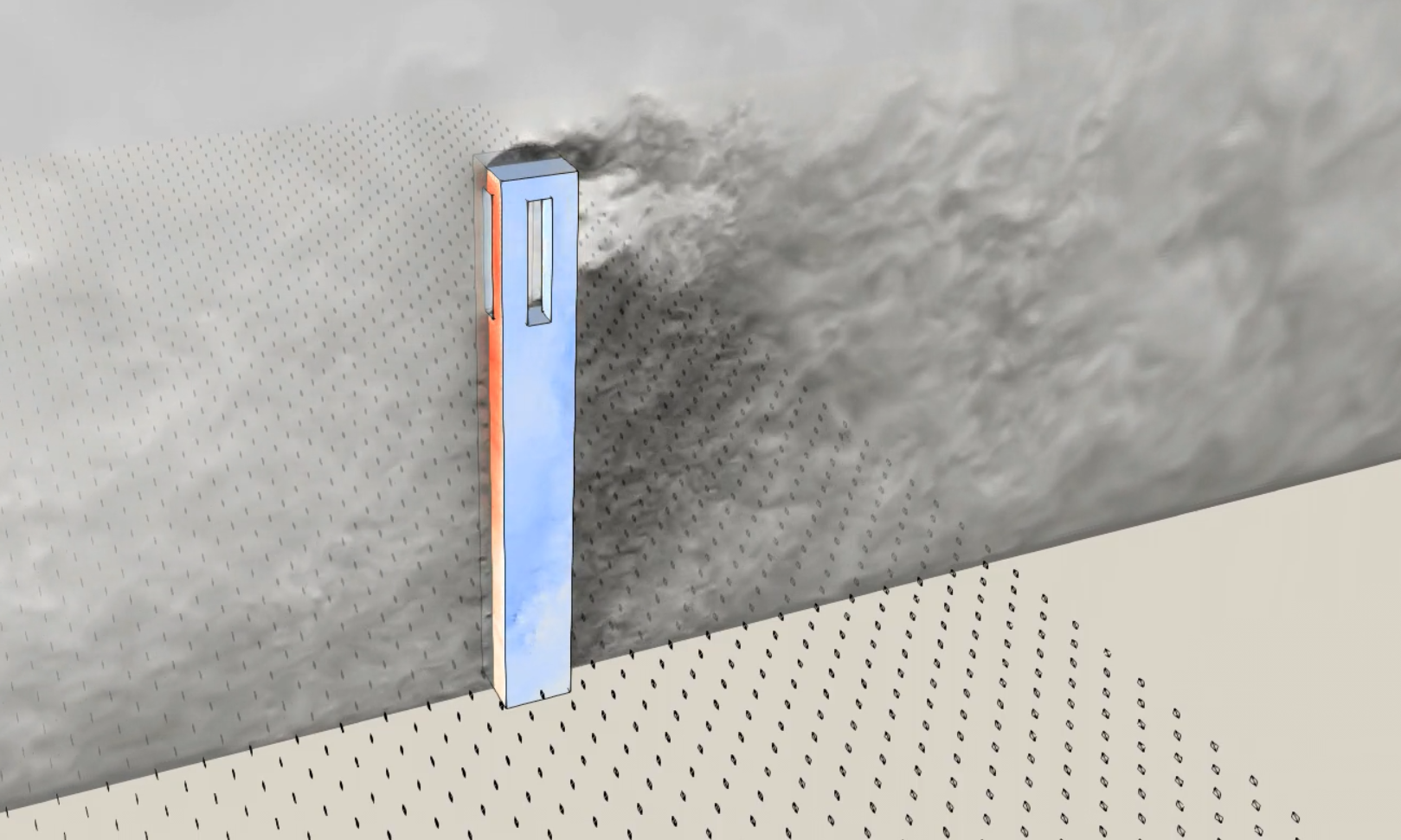
- Vortex shedding and wake dynamics. Bluff body flows feature large-scale vortex shedding with characteristic Strouhal frequencies. RANS either suppresses this or, in unsteady RANS (URANS), over-damps the resolved scales. LES resolves the dominant wake structures, enabling direct verification of Strouhal numbers against experimental data.
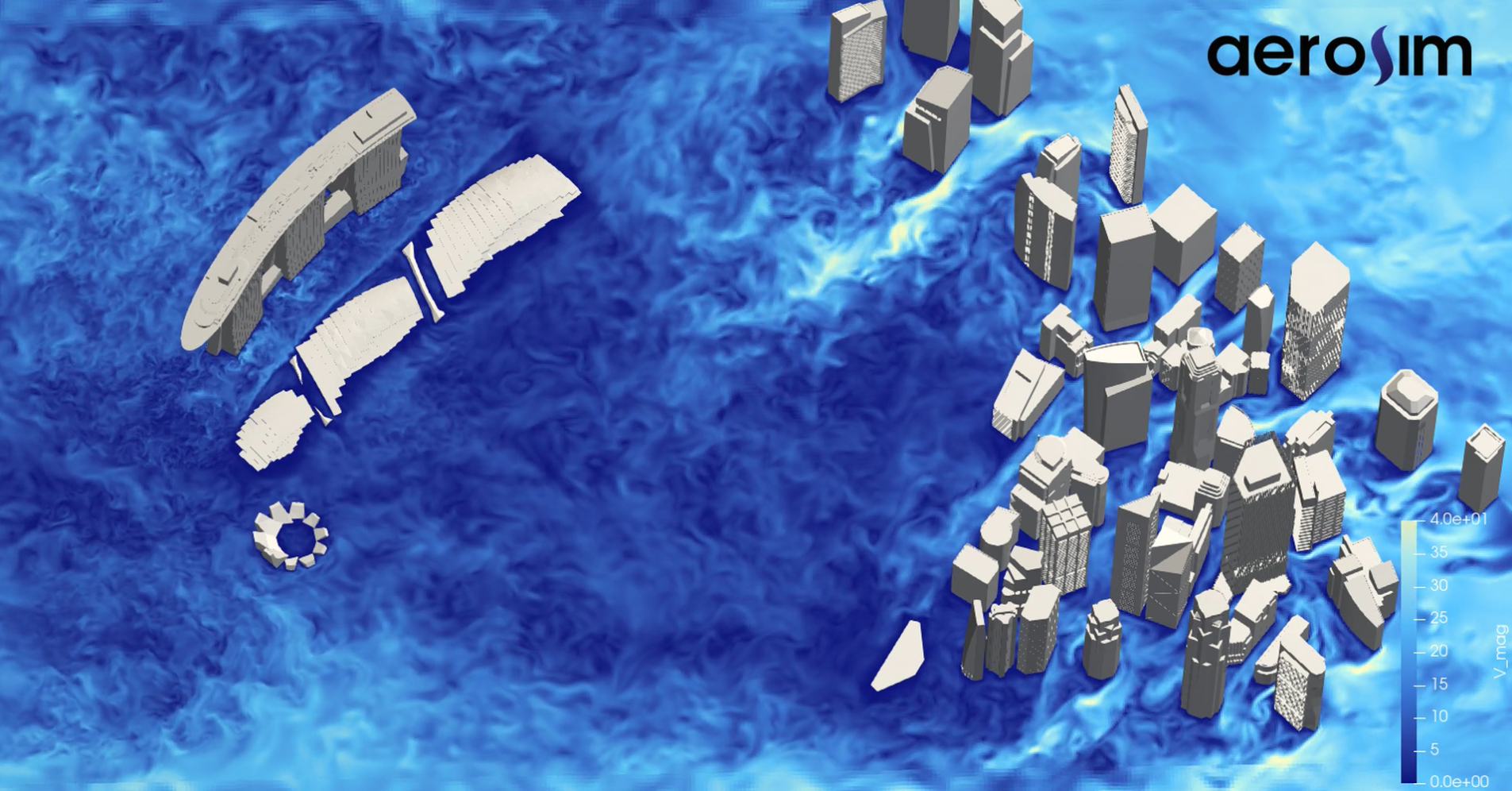
- Pedestrian-level wind. Comfort criteria (Lawson, NEN 8100) require gust statistics - the probability of exceeding threshold wind speeds over time. A mean velocity field does not provide this. LES produces the full velocity time series from which exceedance probabilities can be computed directly.
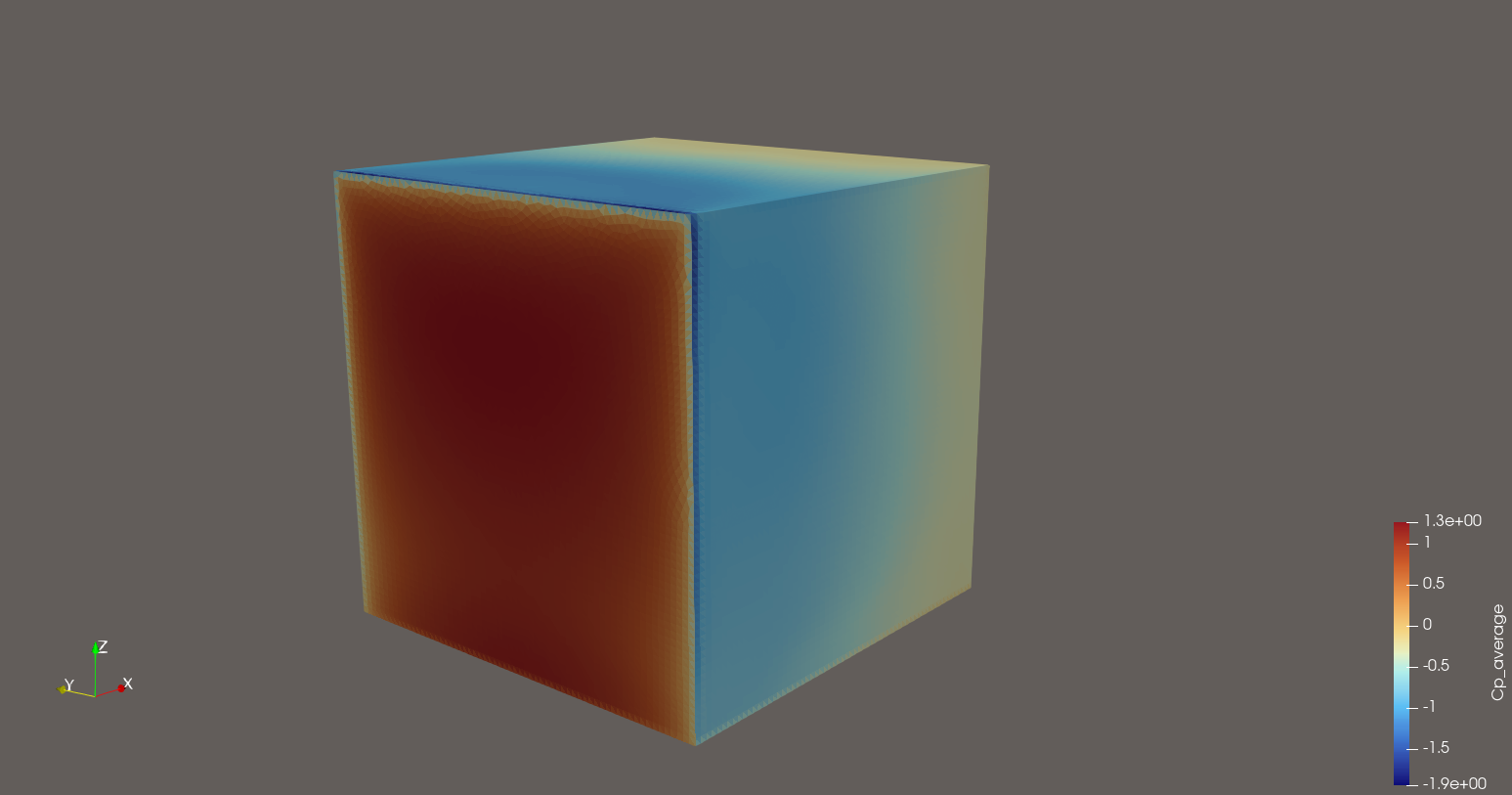
- Peak pressure loads. Wind codes like EN 1991-1-4 require peak pressure coefficients ( extremes), not just mean values. RANS yields a mean pressure field only; no pressure time series is available for peak extraction. LES resolves the transient pressure field directly, providing time histories from which peak factors can be computed without statistical correction.
How LES Works
A turbulent flow contains eddies spanning a wide range of scales. The energy cascade transfers kinetic energy from the largest, most energetic structures down to the smallest scales, where viscous dissipation converts it to heat. Direct Numerical Simulation (DNS) resolves every scale - computationally prohibitive at engineering Reynolds numbers ().
LES introduces a spatial filter. Any flow variable is decomposed into a resolved (filtered) component and a subgrid fluctuation :
In practice, the grid itself acts as the filter: motions larger than the mesh spacing are resolved; smaller motions pass through the mesh and must be modeled. The LES cutoff should fall within the inertial subrange - the scale range where energy is transferred but not produced or dissipated. This ensures that the resolved field captures the energetically significant structures while the subgrid model handles only the universal, dissipative tail of the spectrum.
Subgrid-Scale Modeling
The unresolved scales exert a stress on the resolved field - the subgrid-scale (SGS) stress - which must be modeled. The Smagorinsky model closes this stress through a subgrid viscosity:
where is the resolved rate-of-strain tensor and is a model constant (typically 0.1-0.17 for wind engineering applications). The total viscosity enters the filtered momentum equations in place of molecular viscosity alone. Near solid walls, where the Smagorinsky length scale overestimates turbulent mixing, equilibrium wall models based on the log-law reconstruct the near-wall stress independently of the SGS formulation.
Why LES Is Becoming Viable
For most of its history, LES was confined to academic research on simple geometries. Resolving the inertial subrange at engineering Reynolds numbers requires mesh counts in the tens to hundreds of millions of nodes - feasible until recently only on large HPC clusters with run times measured in days. Three converging developments have changed this.
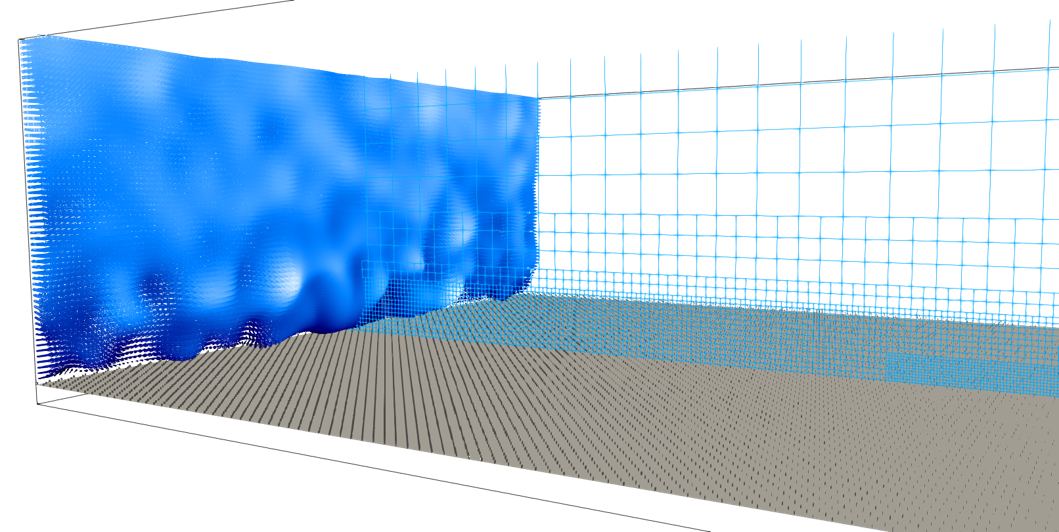
Explicit, local numerical methods. LES is inherently transient; the cost per time step is the critical metric. Finite-volume CFD solvers typically require solving large linear systems at each step - an implicit procedure that does not scale well to very fine meshes. Lattice Boltzmann Method (LBM) solvers use an explicit streaming-and-collision algorithm with no global linear solve. Every operation is local to the lattice node, and the time step follows from an explicit CFL condition. This makes LBM computationally cheaper per node and per time step than pressure-based solvers for transient problems.
GPU parallelism. The LBM algorithm maps directly onto GPU hardware: the streaming step is a structured memory-access pattern, and the collision step is an independent floating-point operation at each node. Modern GPUs provide the memory bandwidth and arithmetic throughput to advance hundreds of millions of nodes per second. Mesh sizes that previously required a cluster can now fit on a workstation GPU.
Tight integration of the SGS model. In AeroSim's Nassu solver, the Recursive Regularized BGK (RR-BGK) collision operator makes the non-equilibrium stress tensor available analytically at each node as a direct output of the collision step. The Smagorinsky subgrid viscosity is then a local correction to the relaxation frequency - no additional field solves, no iterative procedures. LES adds negligible overhead to the base LBM cost, and the RR-BGK operator avoids the spurious ghost moments of standard BGK and the excessive dissipation of regularized BGK, both of which would otherwise compromise the SGS stress computation.
At roughly of GPU memory, a full building case in an atmospheric boundary layer fits on a single workstation GPU and produces the transient pressure and velocity fields that wind engineering analysis requires.
What LES Delivers in Practice
- Peak structural loads. Extract time histories at every surface point. Compute peak factors directly from the simulation instead of applying statistical corrections to mean RANS results.
- Vortex shedding frequencies. Resolve wake dynamics and verify Strouhal numbers against experimental data, critical for crosswind response of slender structures.
- Pedestrian comfort. Compute wind speed statistics at pedestrian height with full turbulence information, enabling direct evaluation against Lawson and NEN 8100 comfort criteria.
Conclusion
LES is not a luxury for wind engineering - it is the method that produces the data wind codes actually require. For most of its history the computational cost made it impractical at engineering scale; the combination of explicit LBM time-marching, GPU parallelism, and tight SGS integration has removed that barrier. The result is transient, spatially resolved wind data on engineering-scale domains, produced on hardware that fits in an office.

Waine Oliveira Jr.
CEO & Founder
Waine is a computer engineer, with over 7 years of hands-on experience in numerical simulations for Computational Fluid Dynamics (CFD) using the Lattice Boltzmann Method (LBM).